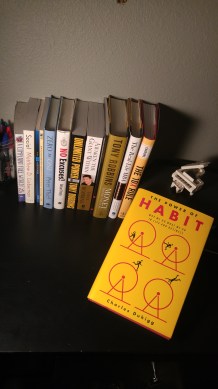
 The Power of Habit, by Charles Duhigg
Why We Do What We Do In Life and Business
Habit is a central part of life. Whether we realize it or not we follow our patterns day in and day out. When you woke up this morning you probably went right in to your morning routine without even thinking about it.
The Power of Habit, written by a New Mexico native (as am I!), reads like a Malcom Gadwell book. It brilliantly explains how habits are relatively simple at first glance, but underneath they are powerful cycles that drive our lives and businesses without us having to think about it.
Habits follow a very predictable pattern:
- Cue
- Routine
- Reward
These three components are the basic building blocks for a habit. So how do these play out? Imagine, for example, a snacking habit. In its most basic form you become aware that you’re hungry and you go for a snack and when you eat you feel satisfied. Your hunger is the cue to go ahead and eat (the routine) and the satisfaction you feel afterwards is the reward. It’s as simple as that.
If it’s so simple, then why do some habits fail? We’ve all been there, trying to create a new habit only to fail down the line. It used to be a common practice for doctors to prescribe new, strict regimens for patients to follow if they were overweight or unhealthy. The doctors would try to overturn their life all in one go, and this was thought to be the most effective way to change a person’s habit loop. But upon further examination these habits did not stick, and instead they miserably failed. Why? The patients were trying to create completely new habit loops. It is very hard to overwrite an already existing habit with a new one. I won’t go into the science of it but the book does well at explaining it. So while we’re not looking at science let us look at an incredibly successful habit changing organization that was created almost without any science to back it up: Alcoholics Anonymous. Instead of creating entirely new habits, the 12 step program brings to attention the pattern of habit. In fact, almost all of the 12 steps attempt to bring to mind the cue and the destructive routine that follows. Such an emphasis on the cue sets AA members up for replacing their routine. As they become acutely aware of their cues for drinking they learn to replace their routine with an action such as calling their mentor and realizing they can’t do it alone. This new routine now creates a new positive reward for the individual thus engraining a new path to follow.
So how does this translate over to organizational and societal habits? It happens in very much the exact same way with the cue, routine and reward. However, organizational habits are harder to change course and it requires drive and determination. On the reward side is progress, not only with the one habit that has become the “keystone” habit of the organization but also in multiple areas across different disciplines. This is how Paul O’Neil turned Alcoa around and even Michael Phelps was able to win his races on autopilot, with “keystone habits.”
Michael Phelps visualized swimming every race perfectly in minute detail morning and evening. He even visualized how his warmup laps would go, how every stroke would feel and how the water would roll of his back and exactly how many strokes he would take. He called it “the videotape” and it has undoubtedly served him well in what is now 4 Olympic appearances and 23 gold medals with numerous world records set. This “videotape” visualization was his keystone habit.
When Paul O’Neil took over the struggling Alcoa, he decided to focus on one thing with an unrelenting force: Safety. As an aluminum processing company, factory floors were dangerous and more often than not men would be injured or killed. O’Neil decided that if safety was his focus, not only would productivity increase from better manufacturing techniques and fewer injury days taken by workers but also profitability would increase from higher quality products. Safety would keep O’Neil awake at night and his dedication to this keystone habit would pay off in a big way. Alcoa is now one of the safest places to work, with even fewer injuries than some software development countries.
Now that you understand a little more about how habit works you can begin to apply these principles to your own life:
- Become acutely aware of the cue for a habit you want to change
- Replace the routine with the new one you desire
- Find a reward that makes it worth it.
What is a habit that you would like to see in your life and why? Comment below!
For me I want to practice gratitude as part of my morning routine. Whenever I practice gratitude I place myself in an unstoppable state and I would like to start each and every day off in this way
If you want a copy of The Power of Habit, by Charles Duhigg you can get it here!
Happy Reading!
 Books for Success