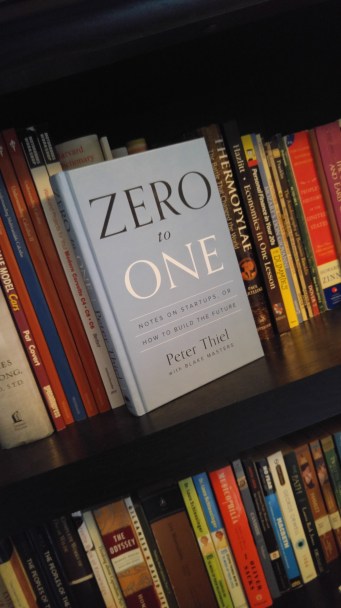
 Zero to One
 Creating the Future
When a book by a billionaire comes your way you would be well advised to pay attention. Not only is Peter Thiel a billionaire, but he was co-founder of PayPal and Palantir, and is also an investor in Facebook and Tesla. So, when it comes to startups, this man knows what he is talking about.
Zero to One deals with startups and what makes some successful and others failures. Thiel explains that going from zero to one is the most likely path for a successful startup. Zero to one means creating something entirely new that revolutionizes a particular area of life. Think back to 2001 when Steve Jobs had returned as CEO of Apple and introduced the iPod. Suddenly we had thousands of songs in our pocket. This was truly a revolutionary product. Nothing like the iPod had really ever been done before. The concept of zero to one is creating something from nothing, creating an entirely new market to monopolize. If you think about it, one is infinitely larger than zero. Why is it that restaurants are one of the riskiest businesses to start? First, they require a lot of capital and, second, they don’t really improve on anything. If you think you have an advantage because your grandmother’s secret recipe for spaghetti sauce is the greatest, no offence to your grandma but the average eater won’t have the same bias and probably wouldn’t even be able to tell the difference from one sauce and another. Thiel argues that if you are going to improve on something it has to be a 10x improvement at the least, otherwise you won’t have much of an advantage over the competition and competition is bad for startups.
Why is competition bad? Simply because it eats profits. A few years ago when oil prices were high and airline companies were abundant, airlines had a very tough time turning a profit. Even with higher airfares than we see now, the airlines were only making a few cents per seat sold. If you ask me, that is no place to be if you are a startup. The ideal startup would have a market monopoly. Be careful here to properly evaluate your market. Don’t overgeneralize or over-constrain your market as this may cause you to miss crucial information on your startup’s monopoly, i.e., who the competition is.

The huge buzzword of startups and big organizations alike is culture. What is a good culture? Essentially a good culture is a workplace where time melts away and employees don’t feel bothered to stay at work later. We hear tales of Silicon Valley startups with bean bags instead of desks, and lunch time yoga classes. It sounds cool and all but really the startup culture comes from the initial team. In the initial stages of a startup the founders usually spend so much time together that they practically live together. Thus, their office space becomes more like a living space complete with eccentric visionaries and driven techies. Jeff Bezos of Amazon still keeps a cot in his office after more than 20 years at Amazon.
Really, what a startup needs to survive is the answers to a series of questions. These questions must be the driving forces behind startups in order to succeed. The questions must have good answers to them that enable the company and the founders and employees to take determined action in the right direction.
1)The Engineering Question
Can you create a breakthrough technology instead of incremental improvement?
2) The Timing Question
Is now the right time to start your particular business?
3) The Monopoly Question
Are you starting with a big share of a small market?
4) The People Question
Do you have the right team?
5) The Distribution Question
Do you have a way to not just create but deliver your product?
6) The Durability Question
Will your market position be defensible 10 and 20 years into the future?
7) The Secret Question
Have you identified a unique opportunity that others don’t see?
These seven questions when answered well will help get your startup off on the right foot. It’s hard to recover from a rocky beginning with no clear vision, purpose, or opportunity.
This book has so much valuable information I plan on re-reading it in the future. Even if you aren’t considering starting your own company there are very useful and candid insights about the future that Peter Thiel has to offer. I highly recommend grabbing yourself a copy of Zero to One!
Happy Reading!
 Books for Success