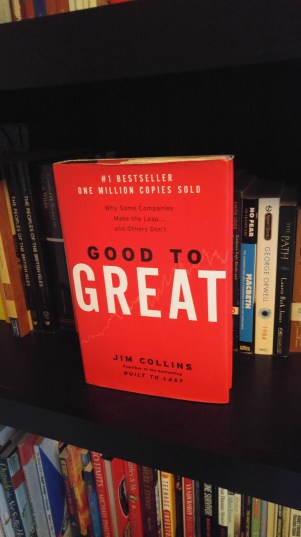
 Good to Great
How do you turn a good company into a great one? Jim Collins and his team examine this question studying 11 enduring companies that went from just good to great over a thirty-year period. Only 11 companies made the rigorous cuts that were chosen to define good to great companies. What Collins and his team found was a very strong pattern in the good to great companies that differed from the comparison average companies. The good to great companies found a level 5 leader, figured out their team, and then decided what to do by confronting the harsh and brutal facts of their present reality. They then created a defining concept and stuck to it creating a culture of discipline. They made effective use of technology to accelerate their growth. All of this was finally used to drive a ‘flywheel’ of momentum to gear the company to be built to last.
So let’s take a look at “Why some companies make the leap… and others don’t.”
-
Level 5 Leadership
It’s not always the charismatic, towering and celebrity personalities that are usually associated with a CEO that transform a company from good to great. Instead it’s hard to miss the fact that outside hired executives were actually negatively correlated with positive transformation of companies. In fact, in the good to great companies examined, 95% of the time the new CEO came from within the company. What made this so significant? These new leaders displayed level 5 leadership characterized by great personal modesty and unwavering resolve. For example, HP was one of the first Silicon Valley companies to create a name for itself in the computer industry. If you visited the billionaire founder Dave Packard’s grave, what would you expect to see? An extravagant inscription detailing the great things he did in life? The opposite is true. Before he died, he gave his entire estate to charity and all that is on his grave reads, “David Packard, 1912-1996, Rancher, etc.” Immense humility with unwavering resolve.
-
First Who … Then What
When the level 5 leader came to the front lines, it would be natural to think that turning the company around required immediate things to be done. New products to launch, new locations to expand to etc. Instead, the new leader of these good to great companies spent most of their time in the initial stages assembling their team. It was hard, especially for Fannie May, who in the 1980’s was losing $1 million a day, to not address their income issues right off the bat. However, assembling the right team made all the difference in the end. The good to great companies found members that were passionate about the company and wouldn’t jump ship when the tough times came. NUCOR, for example, decided to focus on hiring people with farmer-like resolve to work in their steel mills. This paid off for NUCOR as they had “the hardest working steel workers in the world… We hire five, work them like ten and pay them like eight.”
-
Confront the Brutal Facts
I didn’t know this, but Walgreen’s used to be in the restaurant business. Now they are a huge nationwide chain of drug and convenience stores. The guiding question when confronting the brutal facts is, “What can we be the best in the world at?” This is what Walgreen’s did. Just because restaurants was what Walgreen’s had always known didn’t mean that it was the right industry for the company. Walgreen’s saw the opportunity to become the best in the world at convenience stores and seized on that opportunity even though it meant initially killing their main form of business.
-
The Hedgehog Concept
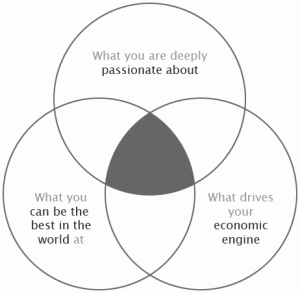
Companies are either foxes or hedgehogs. Being the jack-of-all-trades is never a good move for a company because it inevitably leads to being master of none. The good to great companies focused their resources on the intersection of three main ideas. What they could be best in the world at, what they are deeply passionate about, and what drives their economic engine. When these three ideas are aligned with purpose (not with fanfare) the companies at this point really start to turn around. However, these ideas bring little help when considered with fanfare as becoming the best in the world at something just to say you’re the best ultimately yields unfulfillment.
-
Culture of Discipline
As we go deeper into the transformation of a company we begin to see that laying a groundwork of the previous steps makes the next step easier and momentum builds. If a company has the previous 4 ideas well defined then it should have no problem in creating a culture of discipline. But there is one thing that pushes the good companies to great here. It turns out that the things you aren’t already doing sometimes don’t make as much of a difference as some things you are already doing. Some habits may be hindering. This is why it is just as important to create a “stop doing” list as it is to create a “to do” list. Purging harmful habits and having the discipline to maintain them is crucial for going from good to great.
-
Technology Accelerators
In the last century we have made tremendous leaps and bounds in the realm of science and technology and naturally, companies that don’t change with the technology fall behind. While a new technology can’t change a company alone (Chrysler had one of the first CAD software systems but still struggled) it can certainly give a good to great that final boost of momentum. Walgreen’s was one of the first movers into the age of the internet. However, it didn’t plunge its entire resources into a website. It first experimented with a website then added services and finally released a fully functioning website. This website was aligned with their mission of customer convenience and effectively made Walgreen’s a superpower at the beginning of the internet age.
Even if you aren’t a CEO or even if you don’t have a company, the principles found in this book can be applied to all of our lives. It can be applied to a soccer team, a branch of a company or even our own personal lives. If we search for the right people, have a unifying mission to follow with discipline, and are brutally honest with ourselves (not pessimistic) we can truly take our own lives from good to great.
To get your copy of Good to Great, click here!
Happy Reading!
 Books for Success